
What if the human brain is not a storage device for memories and thoughts, but a receiver a transmitter and filter?
Not a receiver for trivia like the tallest mountain or the best restaurant.
A receiver for deeper information that shapes a life.
Why we feel pulled toward certain people.
Why some ideas arrive fully formed.
Why answers appear suddenly during a walk, a prayer, a fast, or a moment of quiet.
For most of human history, people assumed that the mind could connect to something larger than itself.
A field of intelligence.
A deeper consciousness.
A source of inspiration.
Temples were built around this idea. Meditation traditions formed around it and entire religions were built around the experience of receiving insight.
For most of human history, many cultures believed the human mind could connect to something beyond the physical brain. Ancient civilizations such as Greece, Egypt, India, and early Jewish traditions often described wisdom, prophecy, and inspiration as something people could receive from a higher source.
This view remained common for thousands of years.
In the late 1800s and early 1900s, with the rise psychology, a different model began to take hold. The brain was described as a closed biological machine that generates all thoughts through electrical and chemical activity.
Even though this is the dominant model being taught and promoted today, the lived experience of billions of people suggests something different. Across cultures and throughout history, people consistently report moments where insight, intuition, or inspiration feels less like something they manufactured and more like something they received.
Even though the “brain as a closed machine” model became the dominant narrative, many of the brightest minds in science and philosophy have pushed back against it.
One of the most famous voices who spoke about this idea was the inventor Nikola Tesla.
Tesla believed the universe operated through energy, frequency, and vibration. He often described his mind not as the origin of his ideas, but as an instrument receiving them.
He once said:
“My brain is only a receiver. In the universe there is a core from which we obtain knowledge, strength, and inspiration.”
Tesla did not slowly reason out many of his inventions.
He described seeing machines appear in his mind fully formed. He could run them mentally like simulations before building them physically.
The rotating magnetic field that led to the AC motor, one of the most important inventions in modern history, came to him suddenly while walking in a park.
To Tesla, inspiration often felt like tuning into a signal.
Then there was Wilder Penfield.
Penfield was not a mystic. He was one of the most respected neurosurgeons of the 20th century.
He founded the Montreal Neurological Institute at Mcgill University and spent decades performing thousands brain surgeries while patients were awake, mapping the human brain more precisely than anyone before him.
He stimulated thousands of areas of the brain directly with electrodes.
If thoughts were simply produced by brain tissue, Penfield should have been able to trigger them.
He could trigger movements.
He could trigger sensations.
He could even trigger memories.
But he could not trigger the mind itself.
Penfield eventually concluded that something about human consciousness did not behave like a simple mechanical output of brain tissue.
He wrote that the brain may function more like an instrument through which the mind operates, rather than the mind itself.
His observations led him to question whether the brain might act more like a transmitter or receiver for consciousness.
This idea shocked many scientists at the time.
But Penfield had something most philosophers did not. He had decades of direct interaction with the living human brain.
Other thinkers have echoed similar ideas.
Philosopher William James, one of the founders of modern psychology, proposed what he called the “transmission theory” of consciousness. He suggested that the brain may transmit or filter consciousness rather than produce it.
Physicist Erwin Schrödinger, one of the founders of quantum mechanics, wrote extensively about consciousness as something unified across minds rather than confined inside individual brains.
Even Albert Einstein described human beings as part of a larger whole of consciousness and warned that the illusion of separateness was a kind of optical illusion of awareness.
Across science, philosophy, and spirituality, the same idea keeps appearing.
Maybe the brain is not the generator of consciousness.
Maybe it is a receiver.
Billions already live this way
This is not a fringe idea in human behavior.
Billions of people already act as if it is true.
When someone prays and expects guidance.
When a monk meditates for hours seeking insight.
When a scientist wakes up with the solution to a problem.
When an artist suddenly sees a painting before touching a canvas.
When a founder has a breakthrough in the shower.
When someone hiking alone in nature suddenly understands something about their life.
People say:
“The answer came to me.”
Where did it come from?
Most people do not know.
But they experience the feeling of receiving something.
Signal and Noise
If the brain is capable of receiving insight, the next question becomes:
How clear is the signal?
Human minds are full of noise.
Endless media.
Constant stimulation.
Fear.
Ego.
Trauma.
Chemical imbalance.
Addiction.
Across cultures, people developed practices designed to quiet the noise.
Fasting.
Prayer.
Meditation.
Music.
Nature.
Exercise.
Silence.
These practices appear again and again in different civilizations because they help stabilize the mind.
They help people hear more clearly.
Different Stations
Not everyone tunes to the same frequency.
Some people resonate with monks.
Some resonate with scientists.
Some with prophets.
Some with entrepreneurs, artists, or teachers.
People often feel a powerful sense of alignment with particular guides or traditions.
It can feel like tuning into a radio station that speaks your language.
The Receivers Unite community does not try to decide which station is correct.
It recognizes that different people tune differently.
Throughout history, people have struggled to distinguish between:
intuition and imagination
insight and obsession
dreams and downloads
guidance and ego
Learning to differentiate these things is part of the work.
The goal is not blind belief.

The goal is clarity.
That’s when the idea of TRU community formed. We bring together people who feel they experience strong intuition, insight, or inspiration and want a place to explore and discuss those experiences.
There are billions of people who have experienced moments of profound insight.
But they rarely talk about them openly.
Many assume they are alone.
They are not.
TRU exists to bring these people together.
To discuss how inspiration works.
To explore how the mind becomes clearer.
To build tools and communities that help people use insight productively rather than destructively.
This is not about claiming supernatural authority.
It is about understanding one of the most mysterious human experiences.
The moment when an idea appears from somewhere beyond ordinary thought.
Why Now?
Modern life has created an unprecedented amount of noise.
Endless information.
Algorithms.
Distrust.
Fragmentation.
At the same time, millions of people are searching for clarity.
If the human mind really is capable of receiving deeper insight, learning how to tune that receiver may become one of the most important skills of the future.
We may not yet fully understand consciousness.
But the experience of receiving insight is one of the most universal human experiences that exists.
Tru is a place to explore it.
Together.
Who’s a receiver anyone who understands the model.
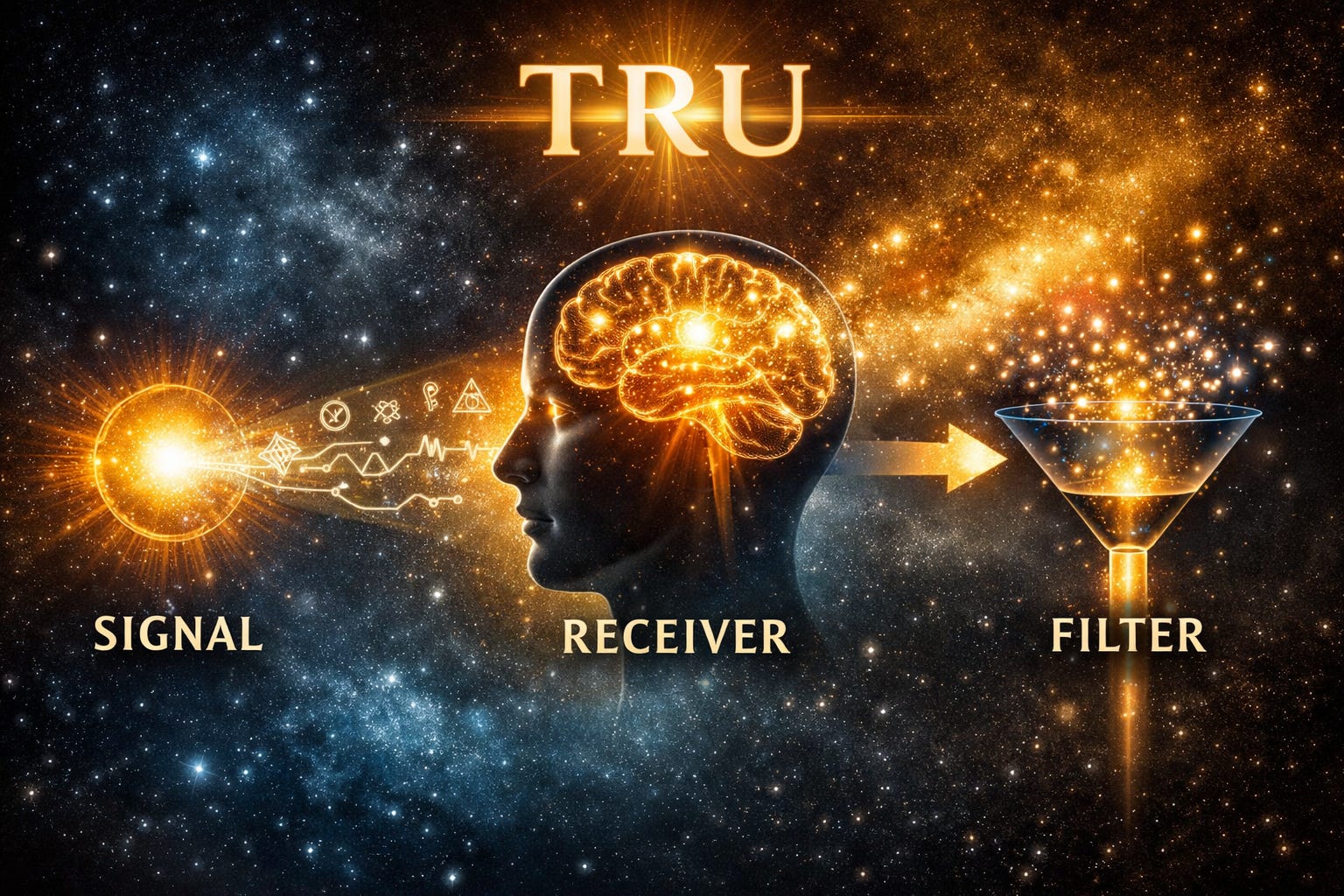
Signal → Receiver → Filter
Receivers detect Signal:
Guidance
Inspiration
Direction
Insight
Ideas
Emotional signals from others
Empathy
Purpose
Perspectives
Solutions, etc..
Then the signal enters the receiver’s filter (brain). This is where the signals are processed, organized, and interpreted. The filter helps the receiver digest the information and decide what it means and what action, if any, should be taken.
If the filter is strong, the signals are processed smoothly and the information is organized clearly.
I plan to launch this community soon. Subscribe here for updates. If you would like to help build this community, you can email thereceiversunite@gmail.com
David,
Can’t wait!